
A bridge loan and a HELOC both turn the equity in the home you own into the down payment on your next one, so you can buy before you sell instead of making a contingent offer. The bridge loan vs. HELOC choice comes down to purpose: a bridge loan is short-term financing built for this one job and repaid when the old home sells, while a HELOC is an open-ended line of credit you generally have to pay off in full when you sell.
Either way, the lender usually qualifies you on both housing payments until the old home is under contract with its financing contingencies cleared. That rule, more than the loan itself, decides which path works.
This guide covers the three paths, how each loan works, when a contingent offer still makes sense, and how lenders count two payments.
How do you buy a house before selling the one you own?
You buy a house before selling the one you own in one of three ways: borrow against your current home’s equity with a bridge loan, borrow against it with a HELOC or home equity loan, or make an offer that is contingent on your sale. The first two give you the down payment now; the third waits for the sale.
| Path | Where the down payment comes from | What it needs from you |
|---|---|---|
| Bridge loan | Equity in the current home, released before it sells | Enough equity, and income to carry both homes plus the bridge loan |
| HELOC or home equity loan | A second lien on the current home, opened before you buy | Enough equity, a line arranged in time, and income for the extra payment |
| Contingent offer | Sale proceeds from the current home | A seller willing to wait on your sale |
Each path also has to clear the lender’s qualifying math, and that is where most buy-first plans succeed or stall. Equity alone does not settle the question; debt-to-income does.
How does a bridge loan work when you buy first?
A bridge loan works by lending against the equity in your current home so you can buy the next one before the first one sells, then paying the bridge off from the sale. As our bridge loan page describes it, the loan is short-term, typically repaid at the sale of your current home, can cover a down payment or the full purchase price, and often comes with an interest-only payment structure.
Fannie Mae’s Selling Guide treats a bridge loan as an acceptable source of funds for the new purchase. Section B3-4.3-14 sets two conditions on a conventional loan:
- No cross-collateral: the bridge loan cannot be secured against the new property.
- Ability to carry everything: the lender must document that you can carry the payments on the new home, the current home, the bridge loan and your other obligations.
The main payoff is a cleaner offer. A bridge loan removes the need to make the purchase contingent on selling first, so the seller is not waiting on a transaction they cannot control.
What should you ask a bridge lender?
Fannie Mae sets no limit on a bridge loan’s term, so the bridge lender sets the terms. Before you sign, get clear answers on:
- the term, and the date the full balance comes due;
- what happens if the current home has not sold by that date;
- whether payments are interest-only, deferred or amortizing;
- the fees and closing costs on the bridge loan itself; and
- whether the current home must be listed, or under contract, before the loan funds.
Bridge loan vs. HELOC: which one covers the down payment?
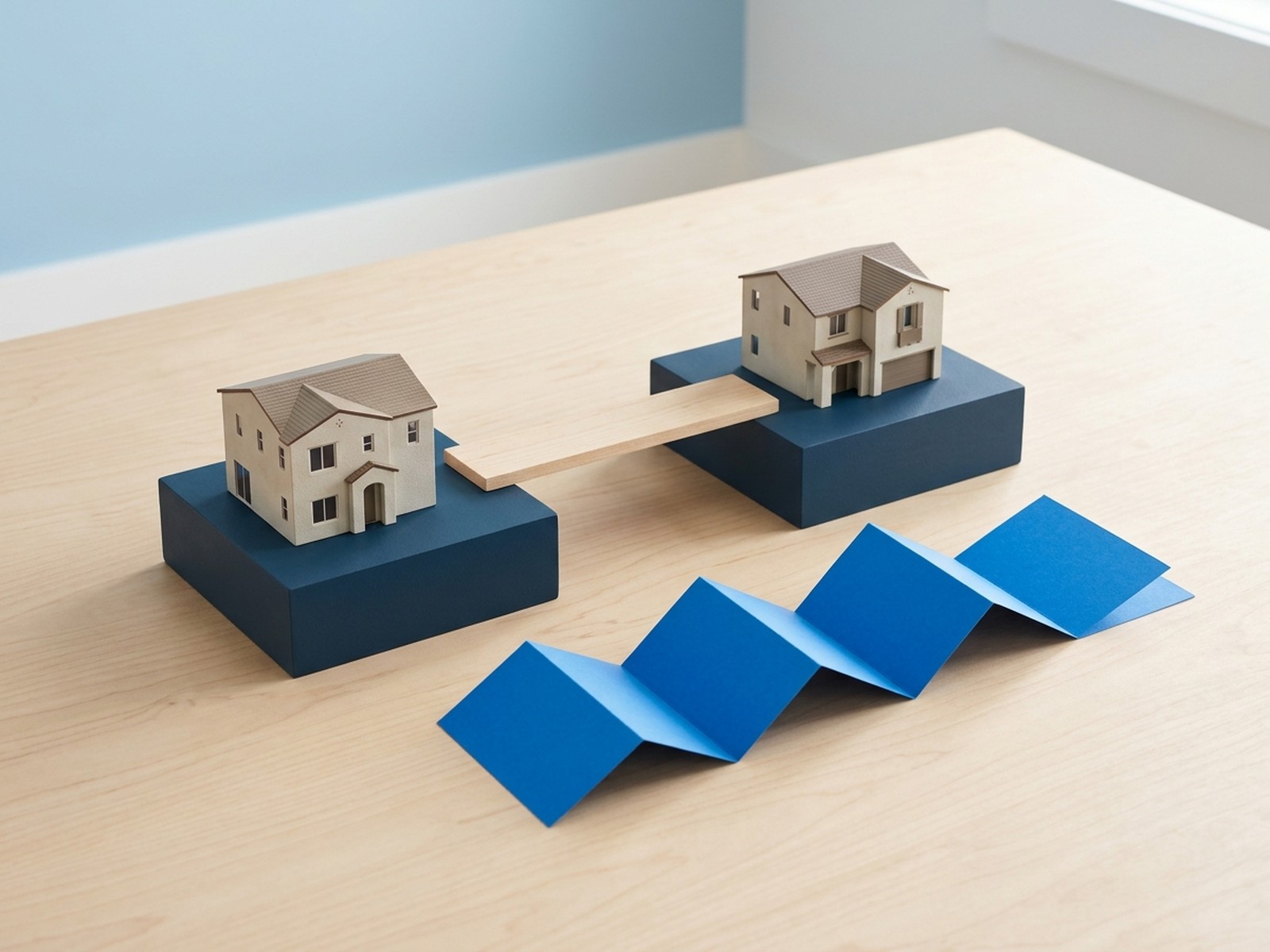
Both a bridge loan and a HELOC can cover the down payment. A bridge loan is designed for that single purchase and is repaid at the sale, while a HELOC is a general-purpose line of credit that has to be in place before you need the money.
How does a HELOC work as a down payment source?
The Consumer Financial Protection Bureau defines a home equity line of credit as an “open-end” line that lets you borrow repeatedly against your equity during a draw period, which “could last 10 years, for example.” HELOCs usually carry variable rates, and a lender can freeze the line if your home’s value drops significantly.
How do a bridge loan and a HELOC compare?
| Bridge loan | HELOC | |
|---|---|---|
| Purpose | Fund the next purchase before the current home sells | Revolving access to equity for any purpose |
| Term | Short-term, set by the bridge lender | A draw period (the CFPB’s example is 10 years), then a repayment period |
| How it is repaid | Typically from the sale of the current home | Monthly payments; generally paid off in full when you sell |
| Payment structure | Interest-only structures are commonly available | Minimum payments based on the balance; usually a variable rate |
| When it must be opened | Arranged around the purchase | Before you need the funds, so it has to be set up in advance |
| If the sale drags | You carry the bridge loan plus both homes until it closes | The line stays open, but the lender can freeze or reduce it if the value drops |
Why does HELOC timing matter when you plan to sell?
HELOC timing matters because the line is tied to the home you are about to sell. The CFPB’s HELOC booklet makes two points that shape a buy-first plan:
- if you sell your home, you are generally required to pay off the HELOC in full immediately; and
- if you are likely to sell soon, consider whether the up-front costs of opening a line are worth paying.
Before relying on a line for a move, ask the lender whether it will open one on a home that is about to be listed.
A home equity loan is the lump-sum alternative. Both HELOCs and home equity loans sit as second liens behind your first mortgage, and the HELOC calculator shows how much equity a line could draw on.
What is a contingent offer, and when does it still make sense?
A contingent offer is a purchase offer that only goes through if a stated condition is met. A home-sale contingency makes your purchase depend on selling your current home first. It is a term in the purchase contract, so the deadlines, release clauses and wording belong with your real estate agent.
When does a contingent offer still make sense?
On the financing side, a contingent offer still makes sense when:
- equity is thin and the old home’s sale proceeds are the down payment;
- cash reserves are low, so two payments at once would strain the budget; or
- debt-to-income cannot carry both homes and a bridge or HELOC payment on top.
How do coordinated closings work?
When sale proceeds fund the down payment, the closings have to line up. Fannie Mae’s section B3-4.3-10 on anticipated sales proceeds requires the lender to verify the money with the settlement statement on the existing home, obtained before or at the same time as the settlement on the new one. Coordinating the two closings is often the practical answer for a buyer who cannot carry two homes.
How do lenders count two housing payments at once?

Lenders count both housing payments in your debt-to-income ratio unless the old home’s sale is far enough along to set its payment aside. Under Fannie Mae’s section B3-6-06, if your current principal residence is pending sale but will not close before the new purchase, the lender must qualify you on both the current and the proposed payment, each including principal, interest, taxes, insurance and association dues (PITIA).
When can the old payment drop out of qualifying?
The exception is narrow. The current home’s payment can be left out only when the lender has:
- the executed sales contract on the current residence; and
- confirmation that any financing contingencies on that sale have been cleared.
Which debt-to-income limits apply?
Both payments then run into the debt-to-income limits in Fannie Mae’s section B3-6-02:
- Desktop Underwriter loans: a maximum total DTI of 50%.
- Manually underwritten loans: 36% of stable monthly income.
- Manual, with qualifying credit and reserves: up to 45%.
How is the borrowed down payment counted?
The borrowed money counts as debt too. Fannie Mae’s section B3-4.3-15 accepts funds borrowed against real estate for the down payment, but the lender must count the loan’s monthly payment, and must calculate an equivalent payment if the loan does not require one.
When the plan relies on sale proceeds instead, the lender estimates them from the sale price minus sales costs and liens. Under section B3-4.3-10, if no sale price is set yet, the estimate is 90% of the listing price minus all liens, adjusted for market conditions. Starting with a preapproval that counts both payments shows which paths are realistic; our guide to preapproval vs. prequalification explains what a preapproval does and does not settle.
Which path fits your situation?

The right path depends on four things: how much equity the current home holds, how much cash you have in reserve, how fast homes are selling, and whether your income can carry two payments. The table matches common situations to the path they tend to point toward.
| Your situation | Path it points toward | Why |
|---|---|---|
| Strong equity, income carries both payments, competitive market | Bridge loan | Removes the sale contingency and is built to be repaid at the sale |
| Strong equity, a line already open or time to open one before listing | HELOC or home equity loan | Draws on existing equity; the payment still counts in qualifying |
| Strong equity, but DTI cannot carry two homes | Contingent offer or coordinated closings | Qualifying on both payments is the binding constraint |
| Thin equity or low reserves | Contingent offer | Sale proceeds are the down payment |
| Current home already under contract, financing contingencies cleared | Standard purchase loan | The old payment can drop out of qualifying |
None of these is fixed. A sale contract signed partway through can change the math, and a bridge loan’s terms vary by lender, so run the numbers against your actual file before choosing.
Frequently asked questions
Is a bridge loan the same as a HELOC?
No. A bridge loan is short-term financing that funds your next purchase and is repaid when your current home sells. A HELOC is an open-ended line of credit you can draw on repeatedly, and the CFPB notes it generally must be paid off in full when you sell.
Can you use a HELOC for a down payment on a new house?
Yes. Fannie Mae accepts funds borrowed against real estate as a source for the down payment, but the lender counts the HELOC payment as debt when qualifying you, and the line generally must be paid off when the old home sells.
Do you have to sell your house before you qualify for a new mortgage?
No. You can qualify while still owning the old home, but the lender must count both housing payments unless it has the executed sales contract and confirmation that the buyer’s financing contingencies are cleared.
Does a bridge loan count against your debt-to-income ratio?
Yes. Under Fannie Mae’s bridge loan rules, the lender must document that you can carry the payments on the new home, the current home and the bridge loan together with your other obligations.
How long does a bridge loan last?
A bridge loan lasts until the bridge lender’s stated term runs out or the current home sells. Fannie Mae sets no specified limit on a bridge loan’s term, so the term depends on the individual loan.
Can you cancel a HELOC after you open it?
Yes, within three days. The CFPB’s HELOC booklet explains that federal law lets you cancel the credit line within the first three days after the account is opened, with notice in writing, and the lender must refund the fees you paid.
Talk through which path fits your move
The rules above are Fannie Mae and CFPB program requirements, not an offer or a commitment of credit. Bridge loan terms, HELOC availability and your qualifying ratios depend on your file. The Taylor Weiner Team is a mortgage lending team based in Seal Beach, lending across California.
Call or text (714) 658-4912, email tweiner@twteam.com, or contact our team. The office is at 1650 Pacific Coast Highway Unit C, Seal Beach, CA 90740. Phones are open Monday through Friday, 8:30am to 7:30pm PST; apply online any time.
Taylor Weiner NMLS 263090 · Lower, LLC · NMLS ID# 1124061 · Equal Housing Opportunity · nmlsconsumeraccess.org · Not an offer of credit or commitment to make a loan; all approvals are subject to underwriting guidelines.