
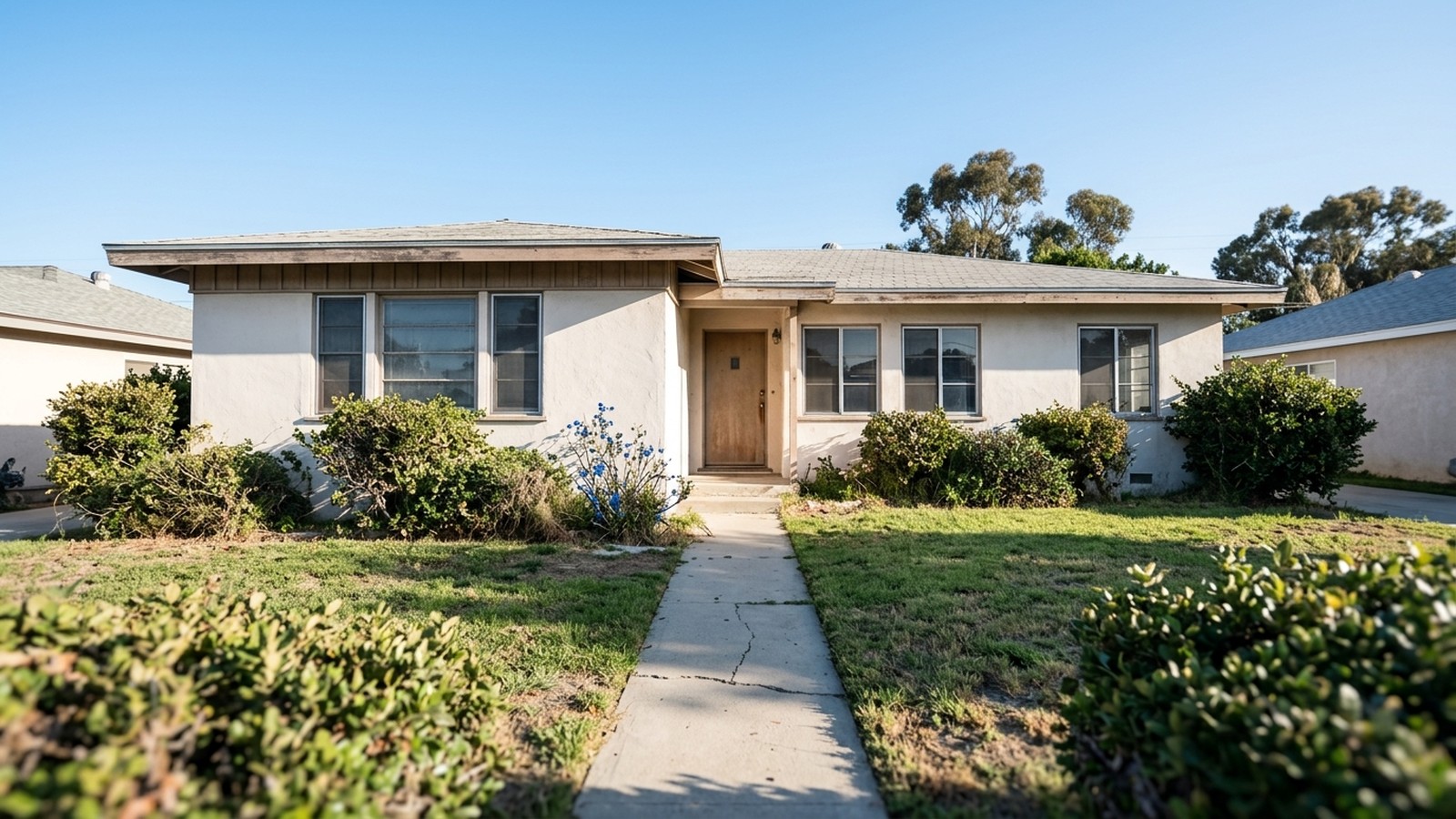
An FHA 203(k) loan and a Fannie Mae HomeStyle renovation loan both roll the price of a home and the cost of fixing it into one mortgage, but they come from different rulebooks. The FHA 203(k) loan is government-insured, limited to a home you will live in, and capped by the FHA mortgage limit for your county. HomeStyle is a conventional loan that also reaches one-unit second homes and investment properties, with no minimum renovation amount.
That difference in backing settles most of the other rules. On the FHA side, the Limited 203(k) covers up to $75,000 of non-structural work and the Standard 203(k) covers major rehabilitation with a $5,000 minimum.
This guide compares the two side by side, then covers the FHA 203(k) loan requirements, eligible work, the draw process and when a renovation loan is the wrong tool.
What is an FHA 203(k) loan?
An FHA 203(k) loan, often written as an FHA 203k loan, is a single FHA-insured mortgage that pays for both the purchase or refinance of a home and the cost of rehabilitating it. HUD describes the 203(k) Rehabilitation Mortgage Insurance Program as insuring one long-term, fixed or adjustable-rate loan on a home that is at least a year old. Part of the loan pays the seller, or the existing mortgage on a refinance, and the rest sits in an escrow account that is released as the rehabilitation is completed.
The program comes in two versions, set out on HUD’s 203(k) program types page:
- Limited 203(k): up to $75,000 for minor remodeling and non-structural repairs. A HUD-approved 203(k) consultant is optional.
- Standard 203(k): major rehabilitation, including structural repairs and additions, with at least $5,000 in repair costs and no fixed maximum. A HUD-approved 203(k) consultant is required.
The $75,000 Limited 203(k) cap applies to FHA case numbers assigned on or after November 4, 2024, under HUD Mortgagee Letter 2024-13, which raised it from $35,000. HUD says it will review the cap each year alongside the national FHA loan limits, so confirm the current figure when you apply.
Like any renovation loan, a 203(k) closes once, and the repair money waits in escrow until the work earns it.
What is a Fannie Mae HomeStyle renovation loan?
A Fannie Mae HomeStyle renovation loan is a conventional mortgage that lets a borrower buy or refinance a home and include the cost of repairs, remodeling, renovations or energy improvements in the loan amount. Fannie Mae’s Selling Guide, in section B5-3.2-01, sets no minimum dollar amount for HomeStyle renovations and no required list of improvements. It does rule out a complete tear-down and rebuild.
Three rules from Selling Guide section B5-3.2-02 shape every HomeStyle loan:
- Property and occupancy: a one- to four-unit principal residence, a one-unit second home, a one-unit investment property, a manufactured home, or a unit in an eligible PUD, condo or co-op project. Condo and co-op work is limited to the interior and must be permitted by the association.
- Renovation budget: on a purchase, the renovation costs cannot exceed 75% of the lesser of the purchase price plus renovation costs or the “as completed” appraised value. On a refinance, the cap is 75% of the “as completed” value; on a manufactured home, it is 50%.
- Loan amount: the mortgage cannot exceed Fannie Mae’s maximum for a conventional first mortgage.
Under section B5-3.2-03, the appraiser values the home as it will be after the planned work. That “as completed” value, not today’s condition, sets the borrowing ceiling.
Freddie Mac’s CHOICERenovation is the parallel conventional option. Freddie Mac, citing Harvard’s Joint Center for Housing Studies, notes that almost 80% of the nation’s 137 million homes are at least 20 years old.
FHA 203(k) vs. HomeStyle: what’s the difference?
The core difference between an FHA 203(k) and a HomeStyle loan is backing. The 203(k) is government-insured and built for owner-occupants, while HomeStyle is a conventional Fannie Mae loan that also reaches second homes and rentals. The table sets the program rules side by side, as of November 2026.
| FHA 203(k) | Fannie Mae HomeStyle | |
|---|---|---|
| Backing | FHA-insured | Conventional, sold to Fannie Mae |
| Occupancy | One- to four-unit principal residence | One- to four-unit principal residence, one-unit second home, one-unit investment property |
| Minimum down payment | 3.5% (96.5% maximum LTV on a principal residence) | Set by Fannie Mae’s Eligibility Matrix; up to 97% LTV is addressed when paired with HomeReady |
| Mortgage insurance | FHA mortgage insurance premium under HUD rules | Conventional mortgage insurance where the LTV requires it |
| Eligible work | Limited: non-structural, up to $75,000. Standard: structural allowed, $5,000 minimum | No minimum and no required improvements; no complete tear-down |
| Loan-limit basis | FHA mortgage limit for the county | Fannie Mae’s conventional maximum for the county |
| Who scopes the work | HUD-approved 203(k) consultant (required for Standard) | Plans and specifications from a licensed contractor, renovation consultant or architect |
| Draws | Standard: up to 5. Limited: up to 4 per contractor | Up to 50% of planned costs at closing, then draws after inspections |
| Contingency reserve | Up to 20% | Optional on one unit; 10% required on two to four units, up to 15% |
| Completion deadline | 12 months (Standard) or 9 months (Limited) | 15 months from closing |
| Doing your own work | Borrower labor is not reimbursed | “Do It Yourself” allowed up to 10% of the “as completed” value |
The FHA rows come from HUD’s program comparison fact sheet (revised November 2024) and the Mortgagee Letters cited here; the HomeStyle rows come from the current Selling Guide.
Beyond that, the choice follows the usual trade-offs, which our comparison of FHA and conventional loans in California walks through.
What are the FHA 203(k) loan requirements?
The FHA 203(k) loan requirements are the ordinary FHA requirements plus a renovation layer. The home must be your principal residence, at least a year old, and financed within your county’s FHA limit, and the work must fit the Limited or Standard track.
- Occupancy: a one- to four-unit principal residence, the only occupancy type HUD’s comparison sheet lists for the program.
- Property: at least one year old; single-family, two- to four-unit, townhome, eligible condo (interior work only) or mixed-use at least 51% residential.
- Loan limit: HUD’s FHA mortgage limits lookup lists Orange County’s 2026 one-unit FHA limit at $1,249,125, against a national floor of $541,287, as of November 2026.
- Down payment: 96.5% maximum LTV on a principal residence, which works out to 3.5% down.
- Permits: all building permits must be obtained before work starts and posted on site, per HUD’s 203(k) consumer fact sheet.
A Limited 203(k) cannot fund repairs that keep you out of the home for more than 30 days in total or need more than four draws per contractor, according to HUD Mortgagee Letter 2026-06. A Standard 203(k) can finance a reserve of up to 12 months of mortgage payments while the home cannot be occupied.
Credit and income rules are the standard FHA ones in HUD Handbook 4000.1. Our FHA loan overview covers the program, and the FHA loan calculator shows how a payment builds.
What can you renovate with a 203(k) or HomeStyle loan?

You can renovate almost any permanent part of an existing home with a 203(k) or HomeStyle loan, from a roof or kitchen to an accessory dwelling unit. Neither loan finances a complete teardown and rebuild from scratch.
What a 203(k) loan covers
HUD’s program page lists eligible 203(k) improvements, including:
- plumbing, heating, air conditioning and electrical systems
- roofing, siding, gutters and downspouts
- structural repairs, additions, and finished attics or basements
- garages, decks, patios, fences and driveways
- kitchen appliances, accessibility and energy improvements
The Limited 203(k) stays non-structural. The Standard 203(k) can rebuild on the existing foundation if a licensed structural engineer confirms it is sound. A 203(k)-financed ADU must be attached to the home.
What a HomeStyle loan covers
HomeStyle sets no list of required or restricted improvements. It allows appliances within a kitchen remodel, finishing a new home that is at least 90% complete, and accessory units, garages and pools where zoning allows.
Why California buyers ask
A house in Seal Beach or Huntington Beach can sit on a valuable lot while its roof, wiring and kitchen are decades old. Both programs expect permits where local law requires them, so a city’s plan-check timeline becomes part of the loan’s completion clock.
How does a renovation loan work from offer to final draw?

A renovation loan works as a sequence: the work is scoped and priced before closing, the home is appraised as completed, and the repair money is paid out in draws as each stage passes inspection.
1. Scope the work and collect bids
For a Standard 203(k), the HUD-approved consultant writes the work write-up and cost estimate. For HomeStyle, a licensed contractor, renovation consultant or architect prepares the plans, and you choose the contractor; the lender may not refer one.
2. Appraise the home as completed
The “as completed” value caps both the loan and the renovation budget.
3. Close and fund the renovation escrow
Under section B5-3.2-04, a HomeStyle lender can release up to 50% of the planned renovation costs at closing. HUD’s comparison sheet allows up to 50% of material costs as an upfront 203(k) draw.
4. Release draws as work passes inspection
On a 203(k), the consultant inspects each stage, the lender pays by two-party check, and funds must be released within five business days of a proper draw request. HomeStyle draws go by joint check, or by wire with your written consent before each payment.
5. Handle overruns and change orders
On a HomeStyle loan, you or the lender must fund cost increases; the loan amount cannot rise to cover them.
6. Certify completion and close out
HomeStyle closes out with a Form 1004D completion certification and a title update clearing mechanic’s liens, per section B5-3.2-05. On a 203(k), the consultant verifies completion before remaining escrow is released.
When is a renovation loan the wrong tool?
A renovation loan is the wrong tool when the house is already livable and the project can wait, when the plan is ground-up construction, or when the property is a flip rather than a home.
- A move-in-ready house with a later project. A purchase loan now and an equity product later can be simpler than bids and draws.
- A ground-up build or full teardown. Neither program fits; that belongs with construction loan financing.
- An investment flip. A short-term resale sits under fix-and-flip lending, not either program here.
- A project you cannot scope before closing. Both programs price the loan from bids written in advance.
Which renovation programs fit a given file depends on occupancy, credit, the property and the scope of work, so ask a lender which ones apply to yours.
Frequently asked questions
Can you use an FHA 203(k) loan on an investment property?
No. An FHA 203(k) loan is for a one- to four-unit principal residence, the only occupancy type HUD’s comparison sheet lists for the program. A HomeStyle loan can finance a one-unit investment property.
How much can you borrow with a Limited 203(k)?
A Limited 203(k) covers up to $75,000 in total rehabilitation costs for non-structural work, under HUD Mortgagee Letter 2024-13. The full mortgage must still fit within the FHA limit for your county.
Is there a minimum renovation amount for a HomeStyle loan?
No. Fannie Mae’s Selling Guide sets no minimum dollar amount for HomeStyle renovations. A Standard 203(k), by contrast, requires at least $5,000 in repair costs.
Can you do the renovation work yourself?
Yes, within limits. HomeStyle’s “Do It Yourself” option allows borrower work on one-unit properties up to 10% of the “as completed” value, approved in advance, with materials reimbursed but not your labor. A Standard 203(k) also allows borrower work identified on the consultant’s write-up, without reimbursement for labor.
Can you build an ADU with a renovation loan?
Yes. A 203(k) can fund an ADU that is attached to the existing home, and HomeStyle can fund accessory units as outdoor structures where local zoning allows them.
How long do you have to finish the renovations?
A Standard 203(k) allows up to 12 months and a Limited 203(k) up to nine months, per HUD Mortgagee Letter 2024-13. A HomeStyle renovation must be finished within 15 months of closing, with Fannie Mae able to extend that to 18 months in rare cases.
Talk through which renovation program fits your file
The rules above are FHA and Fannie Mae program requirements, not an offer or a commitment of credit. Loan programs, investor overlays and your own file decide what applies. The Taylor Weiner Team is a mortgage lending team based in Seal Beach, lending across California.
Call or text (714) 658-4912, email tweiner@twteam.com, or contact our team. The office is at 1650 Pacific Coast Highway Unit C, Seal Beach, CA 90740. Phones are open Monday through Friday, 8:30am to 7:30pm PST; apply online any time.
Taylor Weiner NMLS 263090 · Lower, LLC · NMLS ID# 1124061 · Equal Housing Opportunity · nmlsconsumeraccess.org · Not an offer of credit or commitment to make a loan; all approvals are subject to underwriting guidelines.