
Most DSCR programs require a debt service coverage ratio of at least 1.00, a down payment of 15% to 25%, and a credit score in the 620 to 660 range, and in coastal California it is the ratio, not the credit or the cash, that decides the file.
The arithmetic is not the hard part. Gross rent divided by PITIA is the whole test, and our DSCR loan program page already works it through with a full example. The structural problem is that at Orange County prices, gross rent frequently does not cover principal, interest, taxes, insurance and HOA dues on a 75% loan. A property that clears 1.20 in a cheaper market lands at 0.94 here with nothing wrong with it. What follows is the rest of the requirement list and the levers that move a file from 0.96 to 1.05.
What are the requirements for a DSCR loan?
A DSCR loan qualifies the property, not the borrower, so the requirement list looks nothing like a consumer mortgage application: no tax returns, no W-2s, no employment verification, no debt-to-income calculation. The parameters published on our DSCR loan page describe the test as gross rent divided by PITIA, with 15% to 25% down, a 620 to 660 credit floor, investment property only, and title held in an LLC if you want it; these are that page’s stated terms for the non-QM market, not a quote or an offer.
Around that core sit the requirements borrowers tend not to anticipate:
- An appraisal with a rent schedule. Rent comes from your lease or the appraiser’s Single-Family Comparable Rent Schedule, Fannie Mae’s Form 1007, and lenders underwrite the lower of the two.
- Property eligibility. Investment property only, and condo projects get reviewed: litigation, investor concentration or thin association reserves can sink a unit.
- Entity paperwork. An LLC vesting means articles, an operating agreement, an EIN letter and a good-standing certificate.
- A prepayment penalty. Most DSCR loans carry one, commonly a step-down.
The DSCR calculator will run the ratio on a property.
Why is a DSCR loan not a consumer mortgage?
A DSCR loan is business-purpose credit, and that classification explains most of what feels unfamiliar about it. Regulation Z, the rule implementing the Truth in Lending Act, exempts an extension of credit primarily for a business, commercial or agricultural purpose. Its official commentary goes further: credit extended to acquire, improve or maintain rental property that is not owner-occupied is deemed to be for business purposes, whatever the unit count. The same commentary draws a line worth memorizing: if you expect to occupy the property more than 14 days in the coming year, it is not non-owner-occupied and the rule does not apply.
The consequence is direct. Regulation Z’s ability-to-repay requirement applies to consumer credit transactions secured by a dwelling, and its commentary states the section does not apply to business-purpose credit even when a dwelling secures it. That is why nobody asks for pay stubs, and why the protections you remember from buying your own home are not the frame here. DSCR sits inside the broader non-QM category for that reason.
Why is it hard to reach a 1.0 DSCR in coastal California?
Because prices have outrun rents, and the ratio is a direct comparison of the two. Orange County sits at the statutory high-cost ceiling for agency lending: FHFA set the 2026 baseline conforming loan limit at $832,750 and the high-cost ceiling at $1,249,125, which is 150 percent of the baseline. A county pinned to the statutory maximum is by definition one where home values sit far above the national figure, and rents have not scaled the same way.
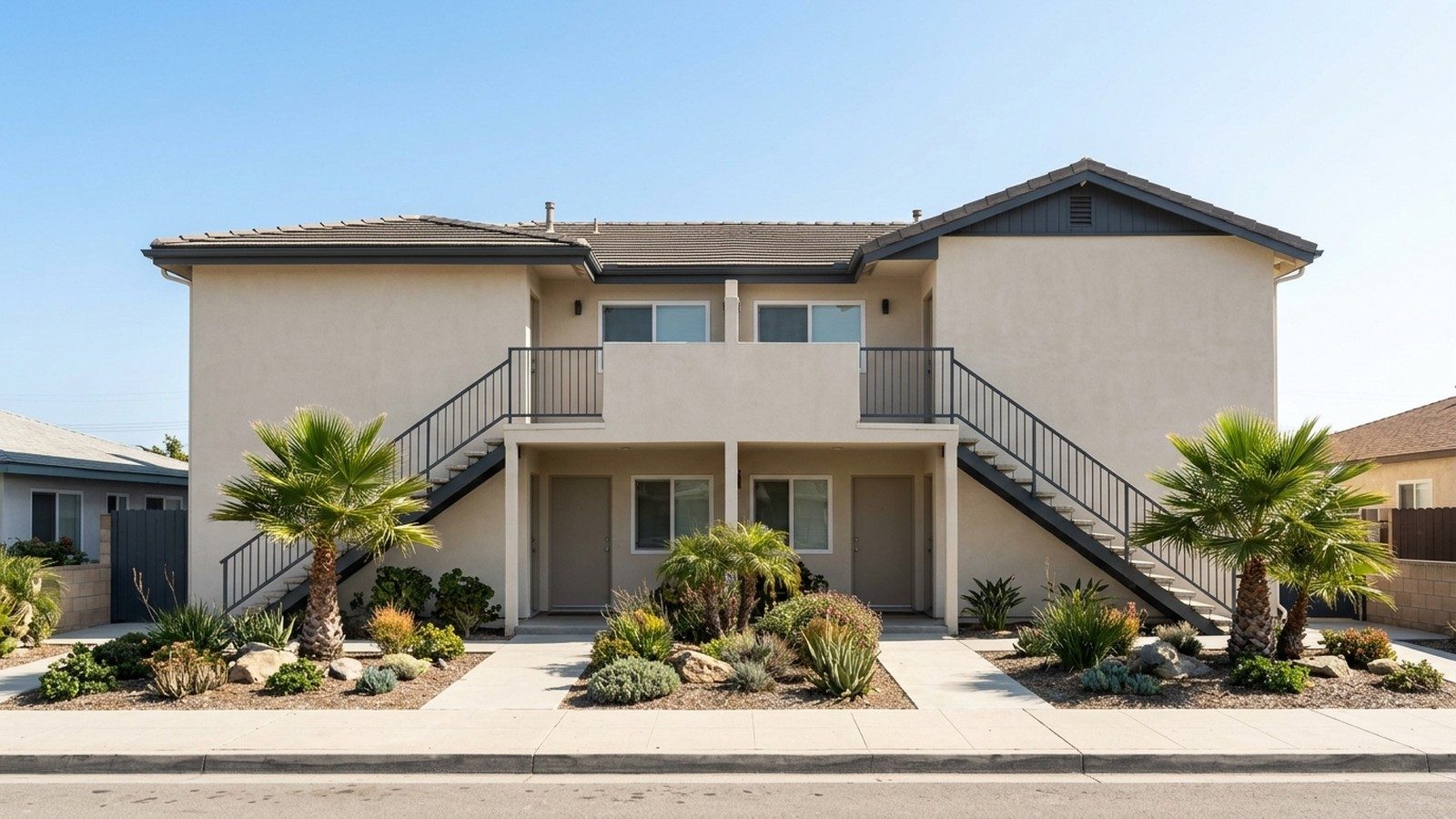
The numbers below are illustrative arithmetic, not a quote, an offer, or a claim about any market. Take a hypothetical two-unit property at $900,000 with 25% down, where monthly PITIA comes to $5,400: $4,100 principal and interest, $790 taxes, $310 insurance, $200 HOA. If the two units together rent for $5,200, the DSCR is 5,200 ÷ 5,400 = 0.96, missing a 1.00 floor by $200 a month. The same rent against a $4,900 payment produces 1.06. The entire gap is the relationship between price and rent in the market you chose.
To sanity-check the rent side of any market, the Census Bureau publishes median gross rent by county and place in American Community Survey table B25064. Set that against local asking prices and the yield problem is immediate.
What DSCR ratio do lenders require, and what changes at each tier?

Most programs set the floor at 1.00. Above and below it, what changes is price, leverage and reserves.
| DSCR tier | What it means | What typically changes |
|---|---|---|
| Below 1.00 | Rent does not cover PITIA | Some programs only; more down, deeper reserves, tighter LTV |
| No-ratio | Cash flow dropped from qualification | The largest down payment and reserves of any tier |
| 1.00 to 1.19 | Covers the payment, little margin | Qualifies on most programs; no pricing benefit |
| 1.20 to 1.25 | Comfortable coverage | Our DSCR page calls this band meaningfully better pricing |
| Above 1.25 | Strong coverage | Supports the lowest down payment tiers |
Two asymmetries are worth planning around. Cash-out refinances usually cap at 70% to 75% LTV and demand a higher ratio than a purchase, so the refinance you are counting on in year three is the harder test. And because the rent input is the lower of the lease and the Form 1007, a lease at $5,200 against a rent schedule at $4,800 underwrites at $4,800, enough to move a 1.02 file to 0.94.
What down payment, credit score and reserves do DSCR lenders require?

Twenty to twenty-five percent down is the standard, with 15% reachable at roughly 740-plus FICO and a strong ratio on select programs, which are the ranges our DSCR page publishes for the non-QM market, not any team’s offer. In a low-yield market the down payment is doing two jobs, because the loan amount is the only large part of PITIA you control at closing. The credit floor sits between 620 and 660 depending on program; a higher score mostly buys leverage rather than eligibility. Reserves run three to six months of PITIA after closing, and six to twelve on cash-out refinances, short-term rentals, or when several files are in process at once, measured after cash to close, which is where California files most often run short.
How do you raise a DSCR on a California property?

Five levers actually move the number, and they trade against each other.
Put more down. The blunt instrument and the reliable one. Continuing the illustrative example: drop from 75% LTV to 65% and the $675,000 loan becomes $585,000. If principal and interest fall in proportion, the $4,100 payment becomes roughly $3,555, PITIA lands near $4,855, and the same $5,200 of rent produces about 1.07. About $90,000 more at closing bought the ratio.
Use an interest-only or adjustable-rate structure. Both reduce the qualifying payment, and a smaller payment is a larger ratio. Both carry real risk: an interest-only period ends, an ARM adjusts. If the ratio only clears because the payment is temporarily lower, you have moved the problem, not solved it.
Buy more doors for the same money. A duplex or triplex at the same price produces more gross rent against one PITIA than a single-family house, often the largest structural improvement available here.
Pressure-test the taxes and insurance. Both feed PITIA directly, and an inflated escrow assumption costs ratio for nothing. Do not plan around the seller’s old tax bill: California reappraises on change of ownership and issues a supplemental assessment at the new value, so underwriting uses the reassessed figure. What you can control is the insurance quote and a current HOA assessment rather than a stale one.
Change the market. The ratio is a function of local yield, and an investor who cannot reach 1.00 on the coast can often reach it inland without changing anything else.
Can you use short-term rental income to qualify?
Yes, with documented history. The terms on our DSCR page call for twelve months of actual short-term rental income through platform payout statements or a 1099, plus confirmation that the municipality permits short-term rentals at that address. Reserves run higher, often six to twelve months.
Two California cautions. Short-term rental ordinances vary city by city along this coast, so a use permitted in one jurisdiction may not be a few miles up the road; resolve that before the appraisal, not after. And the Regulation Z commentary above sets the 14-day line: a beach property you intend to use yourself for more than 14 days is not non-owner-occupied, which changes how the credit is classified.
How does a DSCR loan compare to conventional investor financing?
| Conventional investment-property loan | DSCR loan | |
|---|---|---|
| What qualifies | Borrower’s income and debt-to-income ratio | The property’s gross rent ÷ PITIA |
| Income documentation | Tax returns, W-2s, Schedule E | None |
| Maximum DTI | 50% through Desktop Underwriter | Not calculated |
| Financed properties | Capped at 10 | No cap on most programs, per our DSCR page |
| Loan size | Must fit the county conforming limit | Sized by program, to $3.5 million and beyond per our DSCR page |
| Regulatory frame | Consumer credit; ability-to-repay applies | Business-purpose credit; ability-to-repay does not apply |
| Prepayment penalty | Not typical | Common, often a step-down |
The tax return is what sends most investors here. Residential rental buildings depreciate over 27.5 years under the IRS General Depreciation System, per Publication 527, and between that and ordinary deductions a portfolio that pays for itself in cash can show a loss on Schedule E. How much of that reaches a debt-to-income ratio depends on the lender’s add-backs, but the direction rarely helps.
Frequently asked questions
What DSCR ratio do lenders require?
Most programs set the floor at 1.00, meaning gross rent exactly covers PITIA. Our DSCR page describes 1.20 to 1.25 as earning meaningfully better pricing, and some lenders fund below 1.00 in exchange for more down payment and reserves.
What is the minimum credit score for a DSCR loan?
The floor runs between 620 and 660 depending on program, per our DSCR page. Scores above that buy leverage rather than eligibility; roughly 740-plus is where the 15% down tier becomes reachable.
How much down payment does a DSCR loan require in California?
Twenty to twenty-five percent is the standard range, with 15% available on select programs to strong files. In a low-yield market plan on the upper end, because the down payment is also the most reliable way to lift a ratio over 1.00.
Can you get a DSCR loan if the ratio is below 1.0?
Yes, on some programs. Sub-1.00 and no-ratio structures are used regularly in expensive coastal markets, trading coverage for a larger down payment, deeper reserves and tighter leverage.
Does a DSCR loan count against the 10-property conventional limit?
Fannie Mae’s ten-property cap applies to agency loans, and its count covers one- to four-unit properties on which the borrower is personally obligated. A DSCR loan is not an agency loan and most DSCR programs set no cap of their own, but every DSCR lender still requires a full schedule of real estate owned, and how a specific entity-vested loan gets counted is a question for the lender reviewing the file.
Talk through a California DSCR file
If a property is landing just under 1.00, the useful conversation is which lever to pull and what each costs. The Taylor Weiner Team is based in Seal Beach and lends across California, including Huntington Beach, Long Beach, Los Alamitos, Cypress, Westminster, Fountain Valley, Lakewood and Newport Beach.
Call or text (714) 658-4912, email tweiner@twteam.com, or get in touch here. The office is at 1650 Pacific Coast Highway Unit C, Seal Beach, CA 90740; phones are staffed Monday to Friday, 8:30am to 7:30pm PST, and you can apply online any time.
Taylor Weiner NMLS 263090 · Lower, LLC · NMLS ID# 1124061 · Equal Housing Opportunity · nmlsconsumeraccess.org · Not an offer of credit or commitment to make a loan; all approvals are subject to underwriting guidelines. The ranges here reflect published non-QM program parameters and cited government and GSE figures. They are not rates, quotes, offers or commitments to lend.